
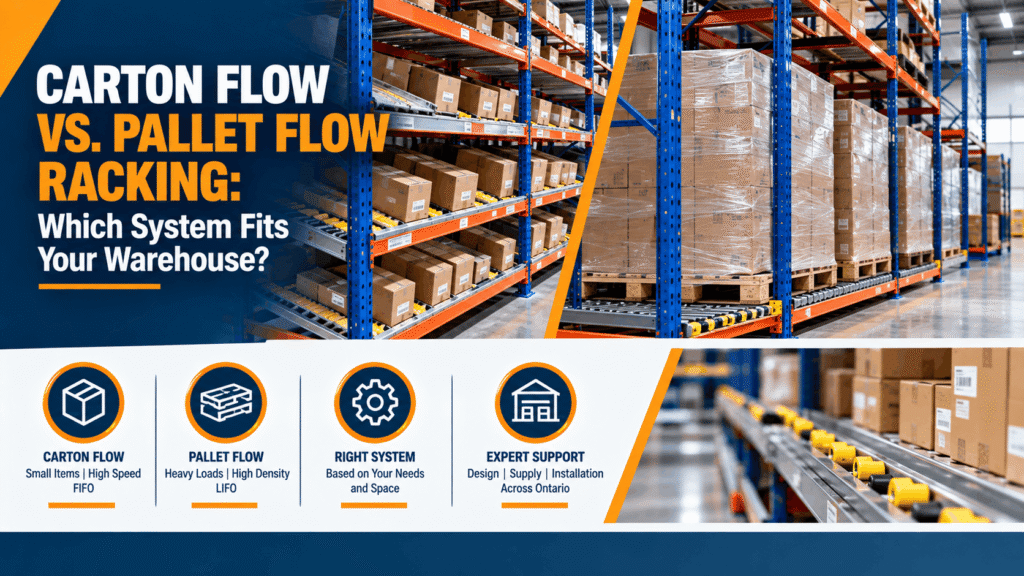
Carton flow and pallet flow racking both move inventory automatically using gravity, but they serve different warehouse needs. Carton flow handles smaller items at high speeds for frequent picking operations, while pallet flow manages heavier, palletized loads for bulk storage. Success Storage Solutions helps Ontario warehouses select and install the right flow racking system, whether carton flow, pallet flow, or a hybrid combination.
Warehouses across Mississauga, Toronto, and the GTA increasingly adopt flow racking to accelerate order fulfillment while maintaining inventory control. Choosing between them depends on your pick rate, SKU variety, load weight, and facility constraints.
What Is Carton Flow Racking and How Does It Work?
Carton flow racking is a gravity-fed storage system for high-speed, high-volume picking. Inclined conveyor rails and braking mechanisms automatically advance each carton toward the pick face as items are removed maintaining continuous flow without manual intervention.
The Gravity and Incline System
Cartons rest on roller-based tracks at a 3–5-degree incline. Gravity moves cartons forward naturally while braking systems control speed. A single loading aisle feeds items from the back; multiple picking positions allow fast access from the front. Damping systems slow movement to 1–2 feet per minute, preventing collision and damage.
FIFO Workflow and Inventory Rotation
Carton flow operates First-In-First-Out (FIFO) automatically—the first carton loaded is the first picked. No manual resequencing required. This makes carton flow invaluable for perishable or date-sensitive products like food, pharmaceuticals, and cosmetics where shelf life is critical. Inventory rotation is guaranteed by the system design itself.
Key Components and Safety Features
Carton flow includes structural frames, inclined rails, roller assemblies with bearings, and braking systems for speed control. Load stops prevent overshooting; end-of-line buffers catch items safely. Load limits are marked on each lane, and regular brake testing ensures safety.
What Is Pallet Flow Racking and How Does It Work?
Pallet flow racking is a high-density, gravity-driven system for palletized goods—typically heavier, slower-moving inventory. It’s engineered for forklift access with deeper lane depths (6–12 pallets) and higher load capacities (1,500–2,500 lbs. per pallet).
Pallet Flow Mechanics and Load Capacity
Pallets ride on nested carts on inclined rails. As a forklift loads a pallet onto the front cart, the entire lane shifts back allowing deeper storage than carton flow. Movement is deliberate and slow, prioritizing stability for heavy loads. Forklift operators load from a single aisle; gravity delivers pallets to the front pick aisle automatically.
LIFO Workflow and Product Suitability
Standard pallet flow operates Last-In-First-Out (LIFO), the last pallet loaded is first retrieved. This works fine for non-perishable, long-shelf-life items like building materials, industrial components, or canned goods. Perishable products should not use standard pallet flow unless you implement lane controls. Pharmaceutical distribution and food warehouses often pair pallet flow (bulk, slow-moving) with carton flow (fast-moving, perishable) in hybrid layouts.
How Do Carton Flow and Pallet Flow Racking Compare?
Both systems use gravity and incline but serve different needs. Carton flow prioritizes picking speed and SKU variety; pallet flow prioritizes storage density and throughput.
| Factor | Carton Flow | Pallet Flow |
| Item Type | Cartons, cases | Pallets, bulk goods |
| Load Capacity | 20–100 lbs. | 1,500–2,500 lbs. |
| Depth Per Lane | 2–6 items | 6–12 pallets |
| Access Method | Hand-pick | Forklift |
| Workflow | FIFO (automatic) | LIFO (standard) |
| Pick Rate | High | Low |
| Space Density | Medium | Very High |
| Ideal For | E-commerce, retail, pharma | Distribution, manufacturing, bulk |
Carton Flow Advantages
Carton flow excels in operations demanding speed. Multiple picks per minute mean faster order fulfillmentcritical for e-commerce and retail distribution. Automatic FIFO ensures perishable products stay fresh without staff intervention. High SKU variety is supported naturally; each lane holds one product. Carton flow requires fewer aisles than selective racking, improving space utilization. Operator efficiency is high picks remain at waist height, minimizing fatigue.
Pallet Flow Advantages
Pallet flow delivers maximum storage density. Storing 6–12 pallets per lane maximizes revenue per square foot. It handles heavy loads carton flow cannot. For bulk operations, pallet flow amortizes system cost efficiently over high volume. Operation is straightforward; forklifts load, gravity delivers. Minimal operator training required.
When Each System Falls Short?
Carton flow’s shallower depth limits bulk storage; slow-moving products don’t fit well. The system operates FIFO only; you cannot switch to LIFO. High-speed movement can damage fragile items. Equipment wear requires ongoing brake calibration.
Pallet flow’s LIFO workflow creates inventory rotation risk for perishables. Lower selectivity means high-variety operations need many lanes, reducing density. Operation is slower—not suited for frequent-pick warehouses. Deep lanes strain forklifts. Pallet flow requires significant capital; it justifies only in high-volume operations.
When Should Your Warehouse Choose Carton Flow Racking?
Carton flow is the right choice when your operation prioritizes picking speed, carries many SKUs, or requires strict FIFO rotation. It excels in e-commerce fulfillment, retail distribution, pharmaceutical warehouses, and third-party logistics hubs. Our warehouse design and layout service maps carton flow into high-velocity workflows.
Carton flow also operates reliably in cold storage and freezer environments (−76°F to +122°F) because it has no electrical components. For perishable and date-sensitive products, automatic FIFO rotation prevents waste and ensures compliance.
When Should Your Warehouse Choose Pallet Flow Racking?
Pallet flow is the right choice when you move large quantities of similar items and need maximum storage density. Manufacturing facilities storing raw materials, distribution centers handling uniform inventory, and wholesale operations with high-volume, low-variety picks all benefit.
Pallet flow suits heavy-load and long-shelf-life products: industrial equipment, building materials, automotive parts, and non-perishable consumer goods. Inventory sitting for weeks before pick justifies the investment.
Can You Use Both Systems in the Same Warehouse?
Yes, and most larger Ontario warehouses do. Position carton flow in the forward-pick zone (closer to shipping) for fast picks. Place pallet flow in reserve/bulk storage (back of facility) for slower-moving inventory. A buffer zone handles load handoffs safely; separate aisles prevent forklift and picker conflicts. Our warehouse design and layout service maps hybrid configurations that leverage both systems’ strengths.
How Do You Design and Install Carton or Pallet Flow Racking?
Both systems require careful facility assessment and professional design. Measure ceiling height, column spacing, and floor load capacity. Verify incline angles (3–5 degrees for carton, 4–6 degrees for pallet). Check floor levelness critical for gravity operation. Confirm Ontario Building Code compliance and CSA A344 standards.
Reference the Ontario Building Code Part 2 Section 2.8 for specific storage facility design and structural load requirements.
Professional installation by Ontario-certified teams ensures precise frame anchoring, rail leveling, and brake calibration. Pre-Start Health & Safety Review (PSR) mandatory in Ontario before operation confirms safety and compliance. Our racking installation and PSR service ensures first-pass compliance and avoids move-in delays.
Is Carton Flow or Pallet Flow Right for Your Warehouse?
Ask yourself: Do you pick individual cartons multiple times per day? → Carton flow. Do you move pallets in bulk, infrequently? → Pallet flow. Do you carry 50+ active SKUs? → Carton flow. Are your products perishable or date-sensitive? → Carton flow (FIFO). Is your space premium? → Pallet flow (density). Is picking speed critical? → Carton flow.
Contact Success Storage Solutions for a free facility assessment. We’ll analyze your SKU profile, pick patterns, and facility constraints, then recommend carton flow, pallet flow, or a hybrid layout tailored to your operation.
FAQs
How fast do cartons move in carton flow racking?
Typical speed is 1–2 feet per minute, controlled by brake systems. Speed adjusts based on incline angle and brake calibration.
Does pallet flow work in cold storage?
Yes. Pallet flow operates reliably in freezers (−76°F to +122°F) because it has no electrical components. Brake systems and rolling carts function without power.
Can you convert a carton flow lane to pallet flow?
No, the systems use different rail profiles, frame weights, and brake mechanisms. Conversion requires complete removal and replacement.
What happens if carton flow brakes wear out?
Worn brakes cause cartons to move too fast, risking collision and damage. Regular inspection prevents wear; PSR includes brake testing.
Can you mix SKUs in the same carton flow lane?
No, each lane holds one SKU only. Mixed SKUs require multiple lanes, which reduces density.