
Every warehouse stores something different. We supply and install the full range, and tell you honestly which one your building can actually take.
Filter by what you are trying to solve, or browse everything. Each system has its own page with specs, capacities and where it beats the alternatives.
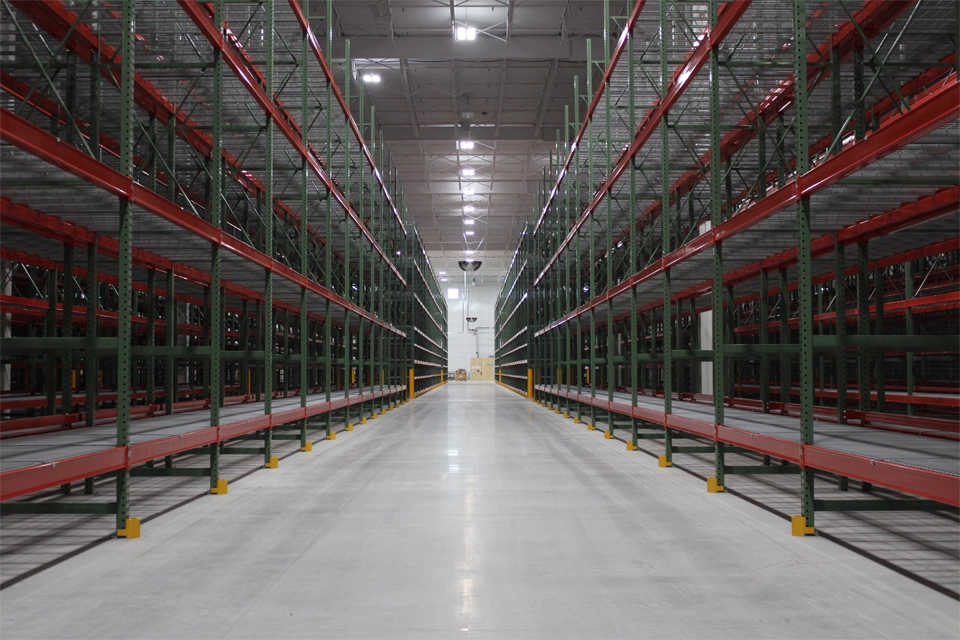 Most Common
Direct access to every pallet without moving another. The default choice when you carry many different SKUs.
 High Density
Forklifts drive into the lane itself. Maximum pallets per square foot when you hold large volumes of few SKUs.
 High Density
Pallets sit on inclined carts, two to six deep, loaded and picked from a single aisle. Density without giving up selectivity.

Two pallets deep on each side of the aisle. Cuts the number of aisles you need, freeing floor for more storage.
 Long Stock
Arms with no front column, so nothing gets in the way of long loads. Built for pipe, lumber, steel and sheet goods.
 FIFO
FIFO
Gravity rollers move pallets from the load side to the pick side. True first in, first out, which matters for dated stock.

Cases roll forward to the pick face as stock is taken. Cuts walking time in high-throughput picking operations.
 Multi-Level
Multi-level structures combining flow racking, walkways and conveyors. Built for order fulfilment that needs throughput.
 More Floor
A second level built inside your existing building. Often doubles usable floor space without moving or extending.

Hand-loaded storage for small parts, spares and slow movers. The right answer when a pallet rack would be overkill.

The racking becomes the building structure, carrying the roof and walls. Used for very high bay and automated facilities.
 Safety
Post protectors, guardrails, wire mesh decking, safety bars and netting. The cheapest insurance in the whole warehouse.
Most people come to us with a system in mind. Often it is the wrong one for their building. Here is the shortcut.
You need more pallets in the same footprint before the lease renewal forces a bigger building.
Your team walks too far per order, and throughput is capped by the layout rather than the headcount.
You store long loads, or product with expiry dates that must move in strict order.
A rough guide only. The right answer depends on your building, your SKUs and your equipment.
| System | Storage Density | Pallet Access | Stock Rotation | Best Suited To |
|---|---|---|---|---|
| Selective | Low | Every pallet | FIFO or LIFO | Many different SKUs |
| Double Deep | Medium | 50% | LIFO | Two pallets per SKU |
| Push Back | High | Front pallet | LIFO | Few SKUs, high volume |
| Drive-In | Very high | Lane end | LIFO | Bulk, single SKU lanes |
| Pallet Flow | High | Pick face | FIFO | Dated or perishable stock |
| Cantilever | Medium | Every load | FIFO or LIFO | Pipe, lumber, long stock |
Book a free site assessment and we will size the right system against your actual pallet counts.