
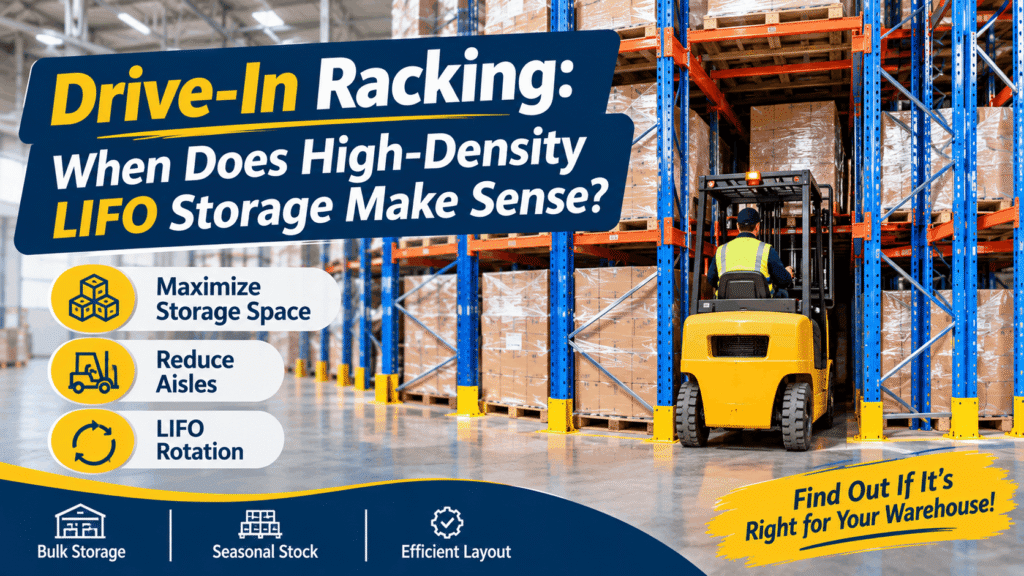
Drive-in racking is a high-density pallet storage system that lets forklifts enter the rack and place pallets several positions deep. It works best when a warehouse holds many pallets of the same SKU and can retrieve them in last-in, first-out (LIFO) order.
For warehouses in Mississauga and across the GTA, drive-in pallet racking can make room for bulk inventory, reserve stock, and seasonal overflow by reducing the number of access aisles. Success Storage Solutions designs these systems around the building, the loads, and the forklifts that will handle them.
How does drive-in racking work?
A drive-in system uses support rails on either side of a lane to hold pallets. A forklift enters through the open end and places the first pallet in the deepest available position. As the lane fills, each pallet is placed closer to the entrance.
What does LIFO mean in a drive-in lane?
The last pallet loaded is closest to the entrance, so it comes out first. For example, if an operator loads three pallets on Monday and two more into the same lane on Tuesday, the Tuesday pallets must come out before the operator can reach Monday’s stock.
Assigning each lane to one SKU helps keep the system manageable. Where lot tracking matters, assign lanes by SKU and lot so newer stock doesn’t block an older batch that needs to ship first.
How does drive-in differ from drive-through racking?
Drive-in racking is loaded and unloaded from the same end. Drive-through racking has access at both ends, so a warehouse can load from one side and pick from the other to support first-in, first-out (FIFO) rotation. The second access aisle needs to be included when comparing layouts.
When is drive-in racking a good fit?
Drive-in works well when the inventory profile gives each lane enough volume to stay reasonably full. Three common applications are bulk reserve storage, production buffers, and selected cold-storage zones.
Bulk stock and seasonal overflow
A beverage distributor, packaging supplier, or retailer may hold dozens of pallets of the same product ahead of a busy period. Dedicated lanes let the warehouse store that volume together while keeping more accessible rack positions available for mixed inventory or daily picking.
Manufacturing and production buffers
Manufacturers can use drive-in lanes to stage uniform raw materials or palletized components for production. A lane assigned to a single component or batch is easier to replenish and draw from when production consumes that stock in predictable quantities.
Cold storage with compatible rotation rules
Deep lanes can help warehouses fit more pallets into a refrigerated footprint. Whether the layout works depends on batch sizes, forklift movements, and product rotation requirements. If products must ship by expiry date, a drive-in lane can make an older pallet difficult to reach when newer stock is stored in front of it.
When should you choose a different racking system?
Drive-in becomes harder to manage when orders routinely call for a specific pallet, when inventory is spread across many low-volume SKUs, or when strict date rotation applies. In those situations, the cost of moving pallets or leaving positions empty can offset the value of extra storage depth.
Selective pallet racking gives operators direct access to individual pallets, which suits mixed-SKU inventory and frequent picking. Pallet flow racking uses gravity-fed lanes with separate loading and picking faces, making it a better fit when stock needs to move in FIFO order.
A warehouse can also use both layouts. Drive-in lanes can hold full-pallet reserve stock, while selective racks keep active SKUs accessible for daily orders.
How much storage capacity can drive-in racking add?
The capacity gain depends on how many aisles the layout can remove and how consistently the operation can fill deep lanes. A six-deep lane assigned to an SKU with only two pallets on hand has four empty positions. If that lane needs to stay dedicated to the SKU, those positions are unavailable to other products.
Compare layouts using both total pallet positions and positions you can realistically fill during a typical week and at peak inventory. Check whether the extra positions still make sense once you account for lot separation, replenishment patterns, and the time forklifts spend entering and backing out of lanes.
A warehouse design and layout assessment can compare those options using your pallet counts, forklift clearances, dock locations, column spacing, and available height.
What should you check before installing drive-in racking?
Start with the actual loads and equipment. Pallet dimensions and condition matter because the pallets need to sit securely on the support rails. The forklift needs adequate clearance inside the lane and sufficient capacity at the required lift height. The design also needs to account for the slab, anchoring, sprinkler layout, and traffic around the lane entrances.
For a retrofit, plan how stock will move while installation is underway. A phased project may let you keep part of the warehouse operating while a designated area is cleared for installation. The warehouse racking installation guide explains how site preparation, approvals, and layout complexity affect scheduling.
What safety and PSR requirements apply in Ontario?
Ontario’s guidance identifies drive-in racks under Item 3 of the Pre-Start Health and Safety Review (PSR) framework. A new installation or a modification to existing racking can trigger a review, unless the workplace can document an applicable exemption. Confirm the requirements for the proposed installation before loading the system.
Once the rack is in use, operators should report forklift impacts, shifted loads, or visible damage promptly. Keep an affected lane out of service if its safety is in question and arrange a qualified assessment. Success Storage Solutions offers rack inspection, repair, and PSR support for facilities that need damage assessed or help with review documentation.
Frequently asked questions
Can drive-in racking be installed in an existing warehouse?
Yes, if the slab, clear height, sprinkler layout, pallet loads, and forklift clearances suit the proposed system. A site assessment can confirm what fits.
How deep should a drive-in racking lane be?
Choose lane depth around the pallet quantities you regularly hold per SKU or lot, the available space, and your forklift clearances. Deeper lanes pay off when you can keep them filled.
Can I use my existing forklift with drive-in racking?
Possibly. Confirm the truck’s dimensions, clearances, and capacity at the required lift height with the racking designer before finalizing the layout.
What should I do if a pallet gets stuck in a drive-in lane?
Stop using the affected lane and follow your site’s safety procedure. Have qualified personnel assess the pallet, load, and rack before attempting recovery.
How often should drive-in racking be inspected?
Set a documented inspection schedule based on the manufacturer’s guidance, traffic levels, and site conditions. Report impacts and visible damage as soon as they occur.
Is drive-in racking right for your warehouse?
Drive-in racking is a strong option when you hold several pallets per SKU, can dedicate lanes to compatible stock, and can work with LIFO rotation. The practical test is whether the layout gives you more usable pallet positions while keeping receiving, replenishment, and shipping workable.
If you’re planning a retrofit or a new warehouse layout in Mississauga or the GTA, request a site assessment . Have your pfallet dimensions, typical quantities per SKU, and forklift model ready so the layout can be sized around your operation.