
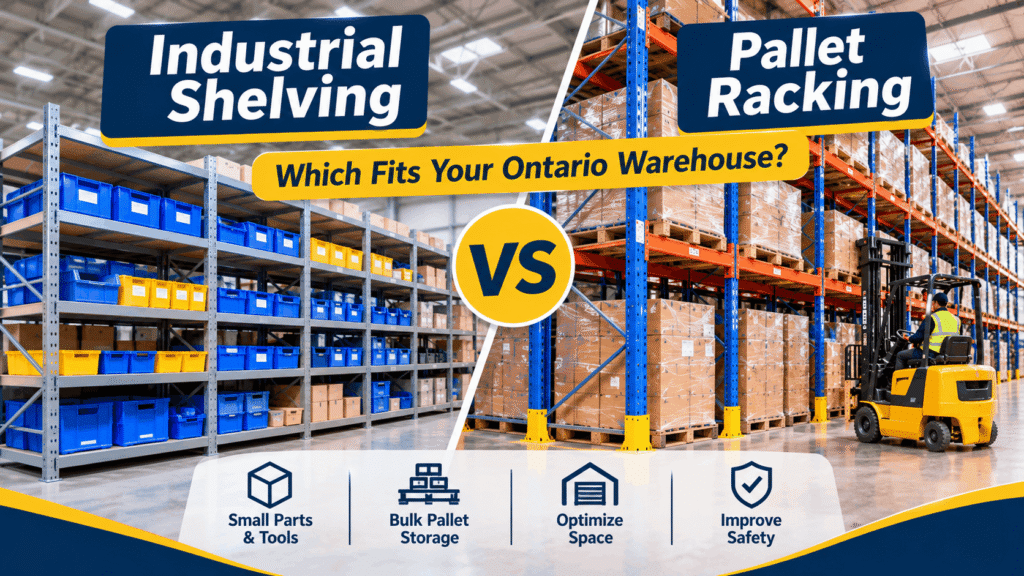
Choosing between industrial shelving and pallet racking starts with how you handle inventory. Shelving generally suits boxes, bins, and parts picked by hand. Pallet racking supports palletized loads handled with forklifts or other suitable lifting equipment.
For Ontario warehouses managing both individual orders and bulk stock, the right answer may be a combination. Success Storage Solutions helps businesses assess their inventory, available space, and material flow before choosing a storage layout.
The goal is to create enough capacity while keeping products accessible and daily work manageable.
What Is the Difference Between Industrial Shelving and Pallet Racking?
The main difference is the load being stored and how workers access it. Industrial shelving creates individual storage locations for hand-loaded inventory. Pallet racking provides engineered positions for palletized goods.
Industrial Shelving for Hand-Picked Inventory
Industrial shelving uses shelf surfaces to support cartons, totes, tools, and loose components. Adjustable levels help match the storage space to the dimensions of the items.
Bins and dividers can separate similar products, while labels give each SKU a clear picking location. This makes shelving useful in maintenance stores, parts departments, and order-picking areas.
Boltless, bolted, open, and enclosed configurations serve different requirements. The choice should reflect load weight, item dimensions, access needs, and the working environment. Industrial shelving is particularly relevant when staff need frequent access to smaller items.
Pallet Racking for Palletized Inventory
Pallet racking uses upright frames and beams to support unit loads above floor level. Its configuration depends on pallet dimensions, load weights, handling equipment, and required access.
With selective pallet racking, each pallet position is directly accessible from an operating aisle. This suits warehouses carrying varied products that need to be retrieved independently. Other configurations trade some direct access for greater storage density.
Racking can also incorporate properly designed lower-level hand-picking locations. The distinction is therefore about the intended application, rather than a rule that every rack holds only full pallets.
When Should You Choose Industrial Shelving?
Industrial shelving is a strong option when workers pick individual products, small cartons, or components throughout the day. Its value comes from making those items easy to identify and retrieve.
Small Parts, Tools, and Spare Components
Maintenance departments and parts distributors often need many separate locations within a compact area. Shelving fitted with bins helps keep fasteners, fittings, replacement parts, and tools organized.
Instead of occupying a large pallet position with a few small boxes, inventory can be divided into clearly labelled locations sized around the products.
Carton and Individual-Item Picking
Shelving can suit businesses fulfilling orders containing individual units or small cartons. Accessible pick faces allow workers to collect stock without retrieving an entire pallet.
However, shelf capacity and safe manual handling are separate considerations. A shelf may support a load that a worker cannot safely lift. Item weight, reach distance, and handling frequency should influence product placement.
Changing Product Dimensions
Adjustable shelving can accommodate changes in box sizes and inventory mix. Moving shelf levels may reduce unused gaps and improve organization.
Any adjustment must remain within the manufacturer’s instructions and the unit’s rated configuration. Taller storage also needs suitable access arrangements; workers should never climb shelving.
When Is Pallet Racking the Better Choice?
Pallet racking becomes more suitable when inventory is received, stored, or dispatched as palletized loads. It allows warehouses to use available height while retaining access through planned equipment aisles.
Bulk Stock and Reserve Inventory
Distributors and manufacturers may hold full pallets that replenish smaller picking locations. Racking provides a dedicated reserve-storage area, keeping bulk inventory separate from day-to-day order picking.
For varied stock, direct pallet access can simplify retrieval. Where an operation stores larger quantities of fewer products, a denser configuration may be worth assessing.
Loads Requiring Mechanical Handling
Heavy or bulky loads need a system designed around their weight, dimensions, and handling method. Choosing racking involves more than finding beams that appear strong enough.
The completed configuration must account for the supporting frames, beam levels, connections, anchorage, and loads. The lifting equipment must also be suitable for the required height and operating space.
Storage That Matches Stock Rotation
Different racking systems support different workflows. Conventional drive-in racking normally operates on a last-in, first-out basis, while pallet flow can support first-in, first-out movement.
Products with expiry dates therefore need a storage and replenishment plan that supports their rotation requirements. Density alone should not determine the system.
How Should You Compare Capacity, Space, and Cost?
A useful comparison considers the complete storage operation. Shelf prices or advertised load capacities cannot show how efficiently a system will work in your building.
Compare the Correct Load Ratings
Avoid treating capacity per shelf, per beam level, and per bay as interchangeable measurements.
A shelving assessment should consider the weight on each shelf and the complete unit. A racking assessment should consider individual pallet loads, beam-level capacity, and frame capacity in the intended configuration.
Use documented ratings for the actual system. Generic capacity ranges can lead to the wrong purchasing decision.
Include Access and Working Space
Shelving needs room for people, carts, picking, and replenishment. Racking needs operating clearances matched to the lifting equipment and loads.
Neither system automatically uses less floor space in every application. Small bins may fit efficiently on shelving, while full pallets benefit from storage designed around pallet handling.
If space is becoming restrictive, reviewing how to maximize warehouse space without expanding can help frame the wider layout discussion.
Assess the Full Operating Cost
Consider equipment, installation, replenishment, travel distance, inspections, and future adjustments alongside the purchase price.
A compact layout can still perform poorly if workers constantly move stock to reach other products. Likewise, adding storage positions may offer little benefit if receiving and dispatch areas become congested.
Can Shelving and Pallet Racking Work Together?
Yes. A combined layout can support warehouses that hold bulk inventory but fulfil orders in smaller quantities.
For example, reserve pallets can remain in racking while selected cartons replenish a shelving area near packing. This gives workers accessible picking locations without placing all reserve stock within the picking zone.
The proportion of shelving to racking should follow order patterns, stock levels, and replenishment frequency. There is no universal percentage that suits every warehouse.
Dedicated replenishment routes and planned pedestrian movement also matter. Adding both systems without coordinating their traffic can create congestion.
A warehouse design and layout assessment can bring product dimensions, equipment clearances, storage zones, and material flow into one plan.
What Safety Requirements Should Ontario Warehouses Consider?
Safety requirements depend on the structure, its use, and the workplace. The original draft’s statement that every industrial shelving installation requires a Pre-Start Health and Safety Review is too broad.
Ontario’s guidance explains that Item 3 PSR requirements concern racks and stacking structures designed for mechanical loading, typically by lift trucks. A PSR is required where applicable unless a documented exemption can be established.
The guidance identifies low-weight shelving loaded by hand from ground level as outside Item 3’s scope. This does not remove the need for safe installation, suitable loading, and maintenance.
Before using a new or modified system, confirm its rated configuration, installation instructions, and applicable review requirements. Keep exits and operating routes clear, and establish inspection procedures appropriate to the equipment and workplace.
If damage or undocumented changes raise concerns, arrange a qualified assessment. Success Storage Solutions offers racking inspection, repair, and PSR services to help assess existing storage systems.
Frequently Asked Questions
Is industrial shelving better for small-parts storage?
Usually, yes. Shelving with bins and dividers provides accessible locations for components, tools, and small cartons picked by hand.
Can pallet racking include hand-picking locations?
Yes. Properly designed racking can combine lower-level picking locations with pallet storage above, subject to suitable loading and safety provisions.
How much weight can industrial shelving hold?
Capacity depends on the shelf dimensions, components, load distribution, and complete unit configuration. Follow the documented rating for the supplied system.
Does every Ontario shelving installation require a PSR?
No. Applicability depends on the system and use. Ontario’s Item 3 guidance excludes certain low-weight shelving loaded by hand from ground level.
Which system is easier to expand?
Both can be expanded where the design and available space allow. Check component compatibility, capacity, access, and review requirements before making changes.
Final Thoughts
Choose industrial shelving when accessible hand picking is the priority. Choose pallet racking when your operation needs engineered storage for palletized loads. Use both where bulk storage and individual-order fulfilment share the same facility.
For an Ontario warehouse, the decision should begin with actual product weights, dimensions, stock levels, and handling methods. Success Storage Solutions can assess those requirements and recommend a layout that supports both storage capacity and everyday access.