
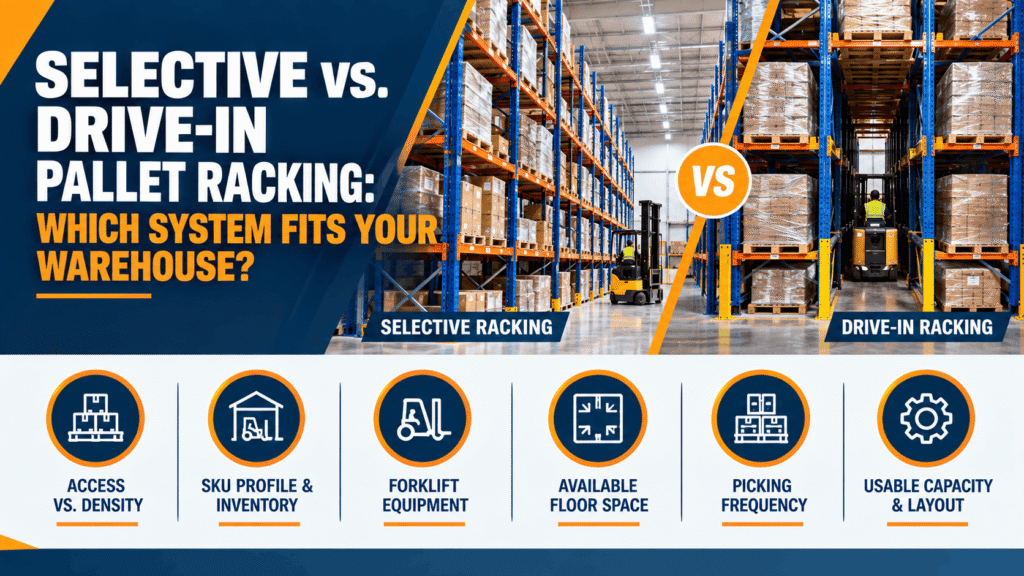
Choosing between selective and drive-in pallet racking is really a decision between access and storage density. Selective pallet racking gives forklift operators direct access to individual pallet positions, making it a strong fit for warehouses with varied SKUs and frequent pallet movement.
Drive-in racking reduces the number of aisles and stores pallets several positions deep, making it better suited to larger quantities of fewer products. Neither system is automatically better.
The right choice depends on your SKU profile, pallets per SKU, inventory rotation, forklift equipment, available floor space, picking frequency, and how efficiently deep lanes can actually be filled.
At Success Storage Solutions, warehouse layouts are designed around those operational factors rather than simply trying to fit the maximum number of racks into a building.
What Is Selective Pallet Racking?
Selective pallet racking is a conventional storage system where pallets are positioned one deep and are directly accessible from a forklift aisle.
Its biggest advantage is selectivity. An operator can retrieve a specific pallet without first moving pallets stored in front of it.
That makes selective racking particularly useful when inventory changes frequently or when many different SKUs have to remain accessible throughout the day.
How Does Direct Pallet Access Help Operations?
Direct access simplifies picking, replenishment, stock checks, and product changes. If a warehouse handles a broad product mix, operators do not need to clear a storage lane before reaching the pallet required for an order.
This can be especially valuable in distribution, manufacturing, retail logistics, and other operations where demand is difficult to predict. Selective rack also makes it easier to adjust storage locations as product quantities change.
Does Selective Racking Support FIFO?
Selective pallet racking can work well with FIFO, but FIFO is not created automatically by the rack itself.
Because every pallet position is independently accessible, warehouse management procedures can prioritize older inventory first. The same physical system can also support other rotation strategies when required.
For date-sensitive inventory, this direct access provides considerably more flexibility than conventional drive-in lanes.
Is Selective Racking Better for High-SKU Warehouses?
Generally, yes. When a warehouse stores many SKUs with relatively few pallets of each product, dedicating deep lanes to individual products can create unused positions. Selective racking avoids that problem because pallet positions can be assigned individually.
The trade-off is aisle space. Giving forklifts access to every rack face requires more operating aisles, so selective racking normally provides less storage density than deep-lane systems.
What Is Drive-In Pallet Racking?
Drive-in racking is a high-density pallet storage system where forklifts enter the rack structure and place pallets several positions deep on support rails.
Instead of providing an aisle beside every rack face, multiple pallets are stored behind one another within the same lane. This dramatically changes how warehouse space is used.
Drive-in becomes attractive when floor space is limited and the warehouse carries significant quantities of the same SKU.
Why Does Drive-In Racking Increase Storage Density?
The biggest space saving comes from reducing access aisles. Selective rack requires an operating aisle to reach individual pallet positions. Drive-in consolidates many pallets into deep storage lanes accessed from one side. That allows a greater percentage of the building footprint to be dedicated to stored product.
However, the important measurement is not simply how many positions appear on the drawing. It is how many positions your operation can actually use.
Why Are Fewer SKUs Better for Drive-In Racking?
A deep drive-in lane normally works best when it can be dedicated to the same SKU, batch, or product group. If a lane is six pallets deep but only two pallets of that SKU are available, the remaining positions may not be usable for unrelated inventory without creating access problems.
For that reason, drive-in works best when there are enough pallets per SKU to keep lanes substantially filled.
Does Drive-In Racking Use LIFO?
Conventional drive-in racking is normally operated using last-in, first-out (LIFO) because pallets enter and leave from the same side.The last pallet placed into a lane is the first one that can be removed.
Where strict FIFO movement is required, drive-through or another system such as pallet flow may be more appropriate because inventory can enter from one side and leave from another.
Why Does Usable Capacity Matter More Than Theoretical Density?
Drive-in may provide substantially more pallet positions on paper, but those positions only create value when inventory can fill the lanes efficiently. This is where honeycombing becomes important.
Honeycombing occurs when empty positions are trapped inside a storage configuration but cannot practically be assigned to another product.
Imagine a warehouse with a six-deep drive-in lane dedicated to one SKU. If only three pallets of that SKU remain, part of the lane may sit unused even though the warehouse technically has open pallet positions.
A warehouse with many shallow SKU quantities can therefore achieve better usable capacity with selective racking even though drive-in offers greater theoretical density.
Before making a decision, a proper warehouse design and layout assessment should compare actual pallet counts, SKU depth, turnover, clear height, columns, forklift requirements, and aisle widths.
Which System Provides Better Forklift Efficiency?
Selective racking usually provides simpler forklift movement because the truck remains in the operating aisle. Operators approach the pallet position, load or retrieve the pallet, and continue through the aisle.
Drive-in requires the forklift to enter a rack lane. As the lane becomes deeper, the operator must travel farther into the structure and reverse back out after handling the pallet.
That makes forklift dimensions, turning characteristics, load size, rack clearances, and operator training especially important.
Drive-in can save considerable building space, but warehouse managers should evaluate whether those space savings justify the additional lane-entry movements required by the operation.
When Should You Choose Selective Pallet Racking?
Selective racking should normally be considered first when warehouse operations depend on accessibility and flexibility.
It is particularly suitable when you:
- Carry many different SKUs
- Frequently retrieve individual pallets
- Have changing pallet heights or inventory profiles
- Need flexible inventory rotation
- Want easy access for stock counts and replenishment
- Have enough floor area for conventional forklift aisles
Selective racking can also be useful when future inventory is difficult to predict because pallet positions can be reassigned more easily than deep dedicated lanes.
When Should You Choose Drive-In Pallet Racking?
Drive-in deserves stronger consideration when the priority is maximizing storage capacity for relatively uniform inventory.
It works particularly well when you:
- Hold large pallet quantities of fewer SKUs
- Can dedicate entire lanes to individual products
- Have limited warehouse floor space
- Store reserve or seasonal inventory
- Can operate effectively with LIFO rotation
- Have suitable forklift equipment and trained operators
Cold storage can also be a strong application because reducing aisle space means more of an expensive refrigerated footprint can be used for product storage.
Can Selective and Drive-In Racking Be Used Together?
Yes, and for many warehouses a hybrid layout is more practical than choosing one system for the entire facility.
Fast-moving products or SKUs requiring frequent access can remain in selective racking, while deeper quantities of slower-moving or bulk products can be stored in drive-in lanes.
This allows each part of the inventory to use the storage method that matches its actual movement. Warehouse design should therefore start with the inventory rather than with a preferred rack type.
Could Push Back Racking Be a Better Middle Ground?
Sometimes neither selective nor drive-in provides the ideal balance.
Push back pallet racking stores multiple pallets deep while keeping the forklift outside the rack structure.
It can provide more density than selective while offering easier handling than a system that requires the forklift to drive into deep lanes.
Push back still typically operates on LIFO principles, so product rotation and pallets per SKU remain important.
For warehouses that need more density but are uncomfortable giving up as much accessibility as drive-in requires, it is worth including push back in the layout comparison.
What Should You Evaluate Before Choosing a Racking System?
The best decision should be based on operational data rather than a general rule. Start with your SKU count and, more importantly, determine the number of pallets held per SKU.
Then evaluate inventory turnover, order patterns, pallet dimensions, pallet weights, forklift specifications, clear ceiling height, sprinkler clearances, building columns, receiving areas, staging space, and future inventory growth.
Success Storage Solutions warehouse design and layout service evaluates these variables and translates them into actual pallet-position counts and warehouse layouts.
That lets you compare selective and drive-in based on usable capacity rather than assumptions.
What Happens After the Racking System Is Selected?
Once the storage system and layout are finalized, engineering and installation become just as important as system selection.
A professional racking installation should follow the approved layout, load requirements, anchoring specifications, clearances, and engineering documentation.
For Ontario facilities, PSR requirements should also be reviewed before the system is placed into service.
Pallet racks and stacking structures can fall under Ontario’s Pre-Start Health and Safety Review requirements. Depending on how the system has been designed, tested, installed, and documented, an applicable exemption may exist.
Success Storage Solutions provides racking inspection, repair and PSR support to help warehouse operators determine the documentation and review their system requires.
Which Is Better: Selective or Drive-In Pallet Racking?
Neither system wins every comparison. Choose selective pallet racking when access, SKU variety, flexibility, and frequent pallet movement are more important than maximum density.
Choose drive-in racking when storage density, bulk inventory, and large pallet quantities per SKU matter more than direct pallet access.
And if your inventory contains both types, do not assume the warehouse needs one universal system. A hybrid design using selective, drive-in, push back, or another racking configuration may make better use of the available building.
The right question is not simply, “Which rack holds more pallets?”
It is:
Which layout gives your warehouse the greatest usable capacity without making your inventory harder to operate?
Success Storage Solutions designs and supplies pallet racking around your actual building, inventory, forklift equipment, and workflow. Book a warehouse site assessment to compare selective and drive-in layouts using real pallet counts and facility measurements.
Frequently Asked Questions
What is the main difference between selective and drive-in pallet racking?
Selective racking provides direct access to individual pallet positions. Drive-in racking stores pallets several positions deep to reduce aisle space and increase storage density.
Is drive-in racking always more space-efficient than selective racking?
It normally provides greater theoretical density, but usable capacity depends on whether your pallet quantities can keep the deep lanes filled. Poor lane utilization can reduce the practical advantage.
Can selective pallet racking use FIFO?
Yes. Because individual pallets are directly accessible, warehouse processes can use selective racking for FIFO or other rotation strategies.
What is the difference between drive-in and drive-through racking?
Drive-in is normally accessed from one side and commonly uses LIFO. Drive-through provides access from both sides, making FIFO-style product flow possible in suitable layouts.
Is drive-in racking suitable for high-SKU warehouses?
Usually not when each SKU has only a small number of pallets. Drive-in performs best when individual SKUs have enough pallet depth to efficiently fill dedicated lanes.
Can selective and drive-in racking be installed in the same warehouse?
Yes. Hybrid layouts are common because selective rack can handle frequently accessed or diverse inventory while drive-in handles deeper quantities of bulk products.