If you’ve ever tried to fit six months of inventory into four months of floor space, you already know racking isn’t just steel and bolts. It’s the difference between a warehouse that runs smoothly and one that stalls at every aisle.
At Success Storage Solutions, this is the first question almost every new client asks: which racking system actually fits my building? Here’s a straight answer, one system at a time.
What Is a Warehouse Racking System?
A warehouse racking system is a structure of vertical frames and horizontal beams built to store palletized or boxed goods above floor level. Instead of stacking pallets directly on the ground, which wastes vertical space and makes stock rotation nearly impossible, racking lets a warehouse use its full cubic volume instead of just its footprint.
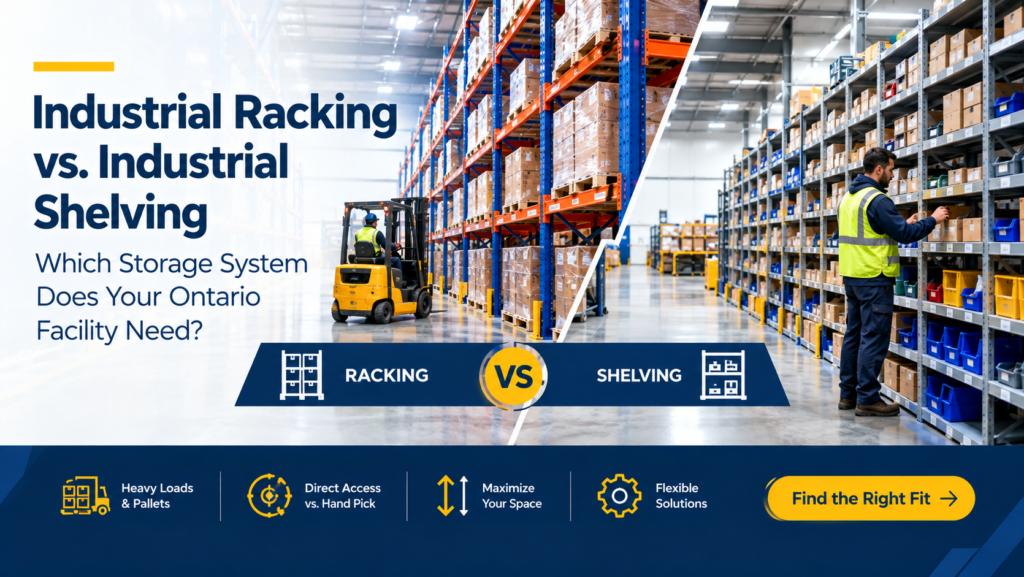
Racking generally falls into two broad families: pallet racking, built for palletized loads, and shelving systems, built for boxes, bins, and smaller items. Most Ontario warehouses end up running a mix of both, depending on what they store and how fast it moves.
How Do You Choose the Right Racking System for Your Warehouse?
Choosing a racking system isn’t about finding the “best” one. It’s about matching the system to how your warehouse actually operates. SKU count matters more than most people expect: a warehouse holding hundreds of products needs direct access to every pallet, while one storing large volumes of a few SKUs can trade accessibility for density.
Ceiling height decides how high you can build before hitting the sprinkler line. Aisle width depends on the forklifts already on your floor, since narrow-aisle trucks open up options standard forklifts can’t reach. Product type matters too, since long or irregular items like pipe and lumber need an entirely different structure than palletized goods.
None of these factors work in isolation, which is usually why a proper site assessment changes the initial recommendation.
What Are the Main Types of Warehouse Racking Systems?
Warehouse racking generally splits into static systems, which stay fixed in place, and dynamic systems, which move product through gravity, carts, or rails. Most Ontario warehouses run a combination of both. Here’s how each of the twelve systems we design and supply works, and where each one earns its place on a warehouse floor.
Selective Pallet Racking
Selective racking is the layout most people picture: vertical frames and horizontal beams giving direct access to every pallet. It suits operations juggling many SKUs with moderate turnover, since nothing needs to move to reach anything else. See our full selective pallet racking page for load and clearance specs.
Drive-In Racking
Drive-in racking removes individual aisles, letting forklifts drive straight into the rack structure to load and unload pallets several deep. It trades accessibility for density, making it a strong fit for bulk storage of a small number of SKUs. Our drive-in racking page covers lane depth in more detail.
Push Back Racking
Push back racking uses inclined rails and rolling carts to store two to six pallets deep per lane, with each new pallet pushing the row back as it loads. It sits between selective and drive-in on the density-versus-access scale. Read more on our push back racking page.
Double Deep Racking
Double deep racking is selective racking stretched two pallets back, doubling density in exchange for needing a reach truck instead of a standard forklift. It works well for warehouses with fewer SKUs and steady turnover. Frame spacing and truck requirements are on our double deep racking page.
Cantilever Racking
Cantilever racking swaps vertical frames for horizontal arms extending off a central column, built for long or awkward loads like lumber, pipe, and steel bar. With no front-facing structure in the way, loading happens from either side. Our cantilever racking page has arm-capacity specs by load type.
Pallet Flow Racking
Pallet flow racking uses sloped roller lanes so pallets glide from the loading end to the picking end under gravity, keeping rotation strictly first-in, first-out. It’s common in food, beverage, and other date-sensitive operations. More detail is on our pallet flow racking page.
Carton Flow Racking
Carton flow racking runs on the same gravity principle as pallet flow but at the case and carton level, making it a common fixture in pick modules and fulfillment zones. It keeps fast-moving SKUs within easy reach without eating into aisle space. See our carton flow racking page for configuration options.
Pick Modules
A pick module stacks multiple levels of racking, shelving, and flow rack into one structure, giving pickers access to far more SKUs per square foot of floor. It’s the go-to system for high-volume, multi-line order picking. Our pick modules page walks through typical layouts.
Mezzanine Floors
A mezzanine adds an entire second floor inside your existing building, turning unused overhead space into storage or picking area without the cost of relocating. It’s often the fastest way to add capacity when moving isn’t an option. Our mezzanine floors page covers structural and load requirements.
Industrial Shelving
Industrial shelving is built for hand-loaded, non-palletized inventory such as spare parts and small items, rather than forklift-handled pallets. It trades storage density for item-level accessibility. Full specs are on our industrial shelving page.
Rack Supported Buildings
In a rack-supported building, the racking itself carries the roof and wall loads, removing the need for a separate steel building frame. It’s a specialized option for facilities planning tall, purpose-built storage from the ground up. Our rack supported buildings page explains how this works.
Rack Protection & Safety Accessories
Guards, decking, and protection accessories aren’t a separate racking type so much as the layer that keeps every system above safe over years of forklift traffic. Column protectors, wire mesh backing, and load signage all belong here. Our rack protection page details what’s typically required.
What Ontario Regulations Apply to Warehouse Racking Systems?
Racking in Ontario isn’t just an engineering decision, it’s a regulatory one. New or significantly modified racking systems fall under Ontario Regulation 851 for Industrial Establishments, which can require a Pre-Start Health and Safety Review before the system goes into use.
That review confirms the installed system meets CSA A344, the Canadian standard governing steel storage rack design and installation. Racking carrying R-Mark certification from the Rack Manufacturers Institute has already been engineered to a recognized safety standard, which simplifies that step considerably.
If you’re unsure whether your existing racking needs a review, our inspection, repair and PSR service is the place to start.
How Does Success Storage Solutions Help You Choose the Right System?
Every project starts the same way, regardless of which of the twelve systems ends up on your floor: a free site assessment. Our team measures clear height, aisle widths, and how product actually moves before recommending anything.
As an executive partner of North American Steel, the racking we recommend is manufactured directly at their Ontario plants rather than imported through a reseller, keeping lead times on the manufacturer’s side of the equation.
From there, our warehouse design and layout team handles the CAD drawings and engineer-stamped plans your review will need.
Frequently Asked Questions
What is the most common type of warehouse racking?
Selective pallet racking is the most widely used system, since it gives direct access to every pallet and works with standard forklifts.
What’s the difference between selective and drive-in racking?
Selective racking accesses every pallet individually. Drive-in racking sacrifices that access for much higher storage density.
How do I know which racking system fits my warehouse?
It depends on your SKU count, ceiling height, and forklift type. A site assessment is the fastest way to get a clear answer.
Is used pallet racking safe to install?
Yes, provided it’s inspected for damage and matched to your load requirements first.
Do I need a PSR for new racking in Ontario?
Most new or significantly modified systems require a Pre-Start Health and Safety Review under Ontario Regulation 851.
Final Thoughts
Twelve systems, one warehouse, and usually more than one right answer. That’s the reality of racking selection. The fastest way through it isn’t more research, it’s a walk-through of your actual floor. Book an assessment with our team and we’ll tell you what your building can hold, not just what it currently does.