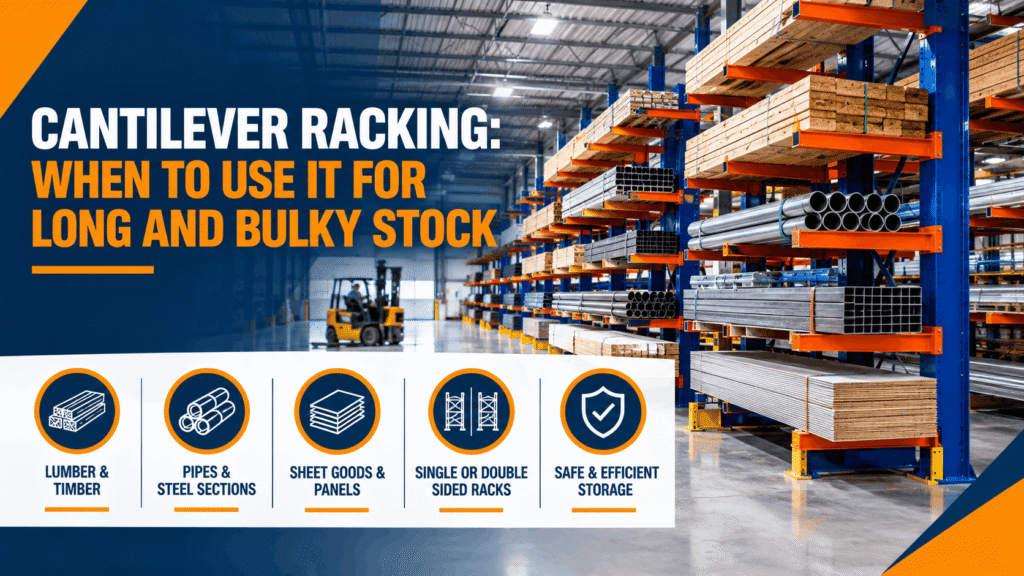
Cantilever racking stores long or bulky materials on arms projecting from vertical columns. With no front uprights interrupting the loading face, it suits lumber, pipes, steel sections and sheet goods that are difficult to accommodate in conventional pallet bays.
At Success Storage Solutions, storage planning starts with the building and the product. For Ontario facilities handling long stock, cantilever racking systems can provide organized storage without forcing materials into unsuitable pallet positions.
The right configuration depends on more than available floor space. Product dimensions, load weights, support requirements and handling equipment all influence whether the system will work effectively.
What Is Cantilever Racking and How Does It Work?
Cantilever racking uses a base, vertical columns, projecting arms and bracing between columns. Materials rest across the arms, which transfer their loads through the columns and bases to the supporting floor.
Unlike conventional pallet racking, the loading face has no front columns dividing it into enclosed bays. This allows long materials to extend across several supports.
Arm levels can be adjusted at the connection positions provided by the manufacturer. They cannot necessarily be placed at any height, and changing the configuration may require a capacity review before reloading.
Which Materials Are Suitable for Cantilever Storage?
Cantilever storage works best when the product can rest securely across correctly spaced supports. Length alone does not establish suitability; rigidity, shape and weight distribution also matter.
Lumber, Timber and Building Products
Lumber bundles, mouldings and engineered wood products are common applications. Separating materials by length or grade can make stock easier to identify than mixed floor stacks.
Boards and panels may need additional supports or approved decking to prevent sagging. Short offcuts also need a suitable storage location rather than being placed across supports they cannot safely span.
Pipes, Tubing and Steel Sections
Pipe racks and steel storage racks organize long materials by size and specification. Round products require suitable containment, such as manufacturer-specified stops or cradles, to reduce the risk of rolling.
The design must reflect the actual bundle weight and how it contacts the arms. Concentrated loads require assessment rather than an assumption that the weight spreads evenly.
Sheet Goods and Other Awkward Loads
Plywood, sheet metal and selected bulky products can suit a properly configured system. Approved decking may provide a continuous support surface where individual arms are insufficient.
Coils, reels and roll goods need application-specific evaluation. They should not be treated as suitable for ordinary cantilever arms simply because they are difficult to palletize.
Should You Choose Single-Sided or Double-Sided Cantilever Racking?
The choice depends on where the rack will stand and which sides operators can reach. Compare the complete footprint, including loading aisles, rather than storage positions alone.
Single-Sided Cantilever Racking
Single-sided racks have arms extending in one direction. They often suit perimeter locations where loading takes place from one aisle.
Positioning a rack near a wall does not make the wall part of its support system. Bases, anchoring and any building connections must follow the approved design.
Double-Sided Cantilever Racking
Double-sided racks have arms on both sides of the columns and generally suit open-floor locations with access from two aisles.
Confirm the permitted loading conditions for each side. Do not assume opposite loads will always balance, or add rear arms to a single-sided rack without manufacturer or engineering approval.
How Do Arm Length, Spacing and Load Capacity Affect the Design?
These dimensions determine whether the rack supports your inventory safely. Start with the longest, shortest, deepest and heaviest loads you expect to store.
Arm Length and Product Depth
Arm projection runs outward from the column and must suit the product’s depth and loading arrangement. The permitted load position depends on the specified arm and configuration.
An arm’s rating is not permission to place that entire weight at its tip. Point loads and uneven loading can differ substantially from the conditions used to establish capacity.
Column Spacing and Material Support
Column spacing determines the distance between supporting arms along the material’s length. Flexible products may need closer supports than rigid products of similar dimensions.
Check the shortest stock as well as the longest. A spacing that supports long bundles may leave shorter items without adequate support. Permitted overhang also needs confirmation.
Arm Ratings and Overall Rack Capacity
Capacity must be checked at arm, column and system level. Adding together arm ratings does not establish the capacity of the complete rack.
Additional levels increase demand on columns, bases and anchors. Use the capacity documentation for the approved arrangement instead of a generic pounds-per-arm range.
Can Cantilever Racking Improve an Awkward Warehouse Layout?
It can make long-stock storage easier to arrange, but it does not remove columns, ceiling restrictions or floor limitations. Both the rack and the moving load need sufficient space.
Plan Around the Full Load Movement
A rack may fit along a wall while leaving insufficient room to turn and retrieve a long bundle. Check the load’s travel path, forklift turning requirements and clearance from pedestrian routes.
Depending on the application, a sideloader or multidirectional truck may suit long loads. Confirm equipment suitability and capacity before setting aisle widths.
Keep Building Constraints in the Plan
Allow for sprinklers, doors, services, structural columns and emergency access. Usable storage height depends on required clearances and the equipment’s operating limits.
A warehouse design and layout assessment helps establish where cantilever belongs alongside staging, picking and other storage areas. An apparently unused corner is only useful if materials can be handled there safely.
When Is Pallet Racking or Shelving a Better Choice?
Choose storage according to the load and retrieval method. Cantilever provides an open face for long stock, while selective pallet racking provides direct access to individual pallet positions.
An open face does not guarantee access to every individual piece. If products are stacked within a bundle or behind other stock, retrieving a specific item may still involve additional handling.
For smaller, hand-picked items, shelving may be more practical. The comparison of industrial racking and industrial shelving explains how the handling method changes the choice.
Many facilities benefit from separate zones for long stock, pallets and small parts rather than one system serving every product.
Can Cantilever Racking Be Used Outdoors?
Yes, when specified for outdoor service. Corrosion protection, foundations and applicable environmental loads must be considered for the location.
Rain, snow and changing ground conditions introduce requirements that differ from an indoor installation. Roofs or canopies also introduce additional design considerations. Confirm the intended use before ordering rather than moving an indoor rack outside later.
What Safety and Installation Checks Apply in Ontario?
Safe installation involves the complete system: rack configuration, anchorage, supporting floor, load stability and handling equipment. An uneven floor needs assessment; cantilever racking is not a workaround for an unsuitable slab.
Ontario’s guidance on racks and stacking structures includes cantilever racks. Where the PSR provisions apply, a review is required unless an applicable exemption is established with adequate documentation.
Confirm the requirement for the specific installation or modification early. Building permits and PSR obligations are separate considerations; obtaining one does not automatically resolve the other.
Success Storage Solutions provides rack inspection, repair and PSR services. Keep drawings, capacity information and installation instructions available, and arrange review of damage or proposed changes before continued use where necessary.
Frequently Asked Questions
How Much Weight Can Cantilever Racking Hold?
Capacity depends on the arms, columns, bases and approved loading arrangement. Use the rating for your exact system rather than a general capacity range.
Can You Store Pallets on Cantilever Racking?
Some engineered configurations can support pallets using appropriate decking or supports. Conventional pallet racking is usually the starting point for standard palletized inventory.
Can Cantilever Arms Be Moved Later?
Often, yes, at the manufacturer’s designated positions. Unload the affected area and confirm whether the new arrangement requires engineering review or revised capacity information.
Does Cantilever Racking Save Warehouse Space?
It can organize long stock vertically and reduce reliance on floor stacks. The result depends on product support, rack dimensions and the loading aisles required.
What Information Is Needed for a Cantilever Quote?
Provide product dimensions, maximum bundle weights, quantity of stock, handling equipment and building details. State whether the system will be indoors or outdoors.
How Can You Choose the Right System for Your Facility?
Start with the stock you actually handle and the space required to move it. A suitable cantilever layout brings product support, access and capacity together before installation begins.
For a Mississauga, GTA or Ontario facility storing long materials, book a site assessment with Success Storage Solutions to evaluate a configuration that fits your inventory and building.