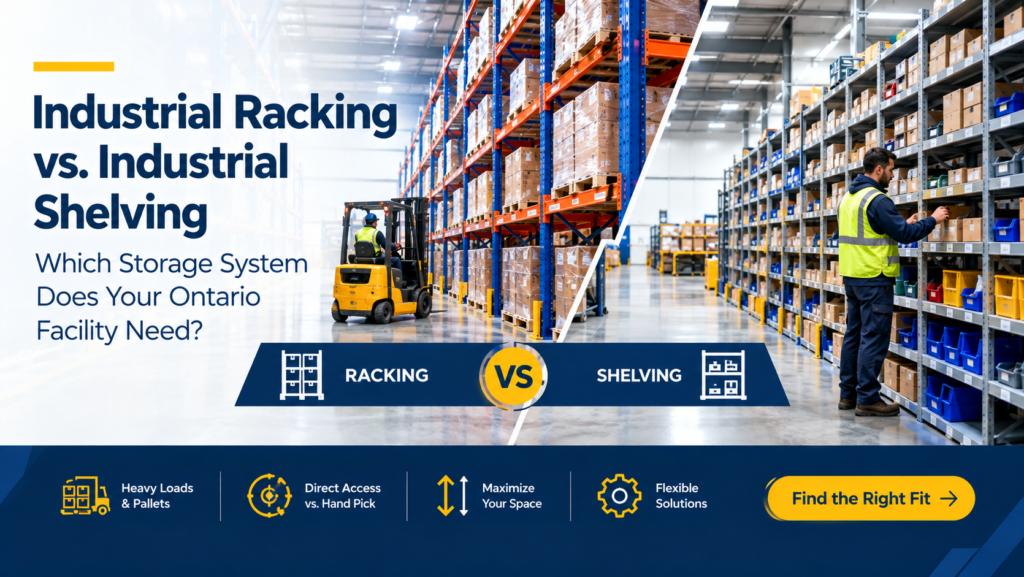
Industrial racking and industrial shelving both organize inventory, but they solve different storage problems. Racking is built for heavy, palletized loads moved by forklift. Shelving is built for lighter, hand-accessed items picked directly by staff. Most Ontario facilities eventually need one system, the other, or a combination of both, depending on what moves through the building every day.
At Success Storage Solutions, we work with warehouses, distribution centers, and manufacturing facilities across the GTA that are trying to answer exactly this question before committing to a layout. Getting the distinction right upfront saves you from a costly redesign later.
What Is Industrial Racking?
Industrial racking is a heavy-duty storage structure built from vertical upright frames and horizontal load beams, engineered to hold palletized goods well above floor level. It’s designed for forklift access, which means aisles, beam heights, and load capacities are all calculated around how a lift truck moves through the space. Racking systems come in several configurations, each suited to a different inventory pattern.
Selective, drive-in, push back, and cantilever racking are among the most common types used in Ontario facilities, and each one changes how quickly pallets can be retrieved versus how densely they can be packed. If you’re still comparing which racking configuration fits your SKU count and turnover rate, our guide on warehouse racking systems breaks down all twelve types side by side.
What Is Industrial Shelving?
Industrial shelving is a lighter storage system built for items that staff handle by hand rather than by machine. Shelving units typically use boltless steel frames with adjustable shelf levels, allowing quick reconfiguration as inventory changes. Unlike racking, shelving doesn’t require aisle clearance for a forklift, so it can be spaced tighter and used in areas where floor space is limited.
This makes shelving the natural fit for small parts, tools, archived records, and picking operations where a worker needs to grab an item and move on without waiting for equipment. Our ustrial shelving solutions are designed for exactly this kind of high-frequency, hands-on access.
What Are the Key Differences Between Racking and Shelving?
The clearest way to separate the two systems is by how they handle weight, access, and flexibility. Racking is engineered for scale and heavy palletized loads; shelving is engineered for speed and manual handling. The table below breaks down how they compare across the factors that matter most when choosing between them.
| Factor | Industrial Racking | Industrial Shelving |
| Load Capacity | Built for heavy, palletized loads | Built for lighter, hand-carried items |
| Access Method | Forklift or reach truck | Manual, by hand |
| Height & Depth | Taller, deeper structure | Lower profile, shallower depth |
| Reconfiguration | Adjustable but more involved to modify | Fast, tool-free adjustment |
| Typical Inventory | Pallets, bulk goods, long materials | Small parts, cartons, tools, records |
When Should an Ontario Facility Choose Industrial Racking?
Racking makes sense whenever inventory arrives on pallets and needs to move at volume. If your operation depends on forklifts to load, unload, and reposition stock throughout the day, racking gives you the vertical capacity and structural strength to support that workflow safely.
High-Pallet-Volume Warehouses and Distribution Centers
Facilities moving large quantities of palletized goods rely on racking to stack inventory well above floor level without sacrificing organization. This is standard across GTA distribution centers handling frequent inbound and outbound freight.
Facilities Running Daily Forklift Operations
Any operation where forklifts are already part of the daily routine benefits from racking’s compatibility with standard lift equipment. When you’re ready to move forward, our racking installation service handles anchoring, leveling, and spacing so your system is built to the correct specification from day one.
When Should an Ontario Facility Choose Industrial Shelving?
Shelving makes sense when items are small enough, light enough, or accessed often enough that a forklift becomes unnecessary overhead. Picking speed and floor space efficiency matter more here than raw load capacity.
Manual Picking and Small-Parts Storage
Operations built around frequent, hands-on picking, like fulfillment stations or parts rooms, move faster with shelving than with rack-and-pallet setups. Staff can reach, retrieve, and restock without waiting on equipment.
Tool Cribs, Archives, and Light Inventory
Maintenance departments, records rooms, and light-inventory storage areas all benefit from shelving’s tighter footprint and easy reconfiguration as needs shift over time.
Can You Use Both Systems in the Same Facility?
Yes, and in practice, most larger Ontario facilities do. A single building might use racking for bulk pallet storage in the main warehouse while running shelving in a parts room, a receiving area, or a picking zone nearby. The two systems aren’t competing solutions; they’re complementary tools for different parts of the same operation.
The challenge is designing a layout where both systems work together without wasting aisle space or creating bottlenecks between zones. Our warehouse design and layout service maps out exactly where each system belongs based on your traffic flow, inventory type, and equipment access.
How Do You Know Which System Fits Your Warehouse?
Start with three questions: how heavy is the typical unit you’re storing, how is it accessed day to day, and how often does the configuration need to change. Heavy, palletized, forklift-handled inventory points toward racking. Lighter, hand-picked, frequently reorganized inventory points toward shelving.
Once racking is part of your facility, keep in mind that new installations and system modifications in Ontario require a Pre-Start Health and Safety Review before they go into operation.
Frequently Asked Questions
Is industrial racking the same as pallet racking?
Yes, pallet racking is the most common form of industrial racking, built specifically to hold palletized loads at height.
Can industrial shelving hold pallets?
Standard shelving isn’t designed for palletized loads; it’s built for hand-carried items, not forklift handling.
Do I need a forklift for industrial racking?
Most racking systems assume forklift or reach truck access, since that’s how pallets are loaded and retrieved at height.
What’s the real difference between shelving and racking?
Racking handles heavy, palletized loads with mechanized access; shelving handles lighter, hand-accessed inventory.
Can racking and shelving be combined in one warehouse?
Yes, many facilities use racking for bulk pallet storage and shelving for picking zones or parts storage in the same building.
Does industrial racking need a safety inspection in Ontario?
New and modified racking systems require a Pre-Start Health and Safety Review before operation under Ontario requirements.
Final Thoughts
Storage decisions don’t have to be complicated once you know what you’re actually solving for. Racking handles the heavy, palletized side of your operation; shelving handles the fast, hands-on side. Most Ontario facilities end up needing both, just in different zones of the same building.
The real work is in the layout making sure each system sits where it earns its space. That’s where a proper design plan turns two separate storage types into one efficient warehouse.
Still not sure which system, or which combination fits your facility? Contact Success Storage Solutions and our team will help you map out the right storage plan for your space.