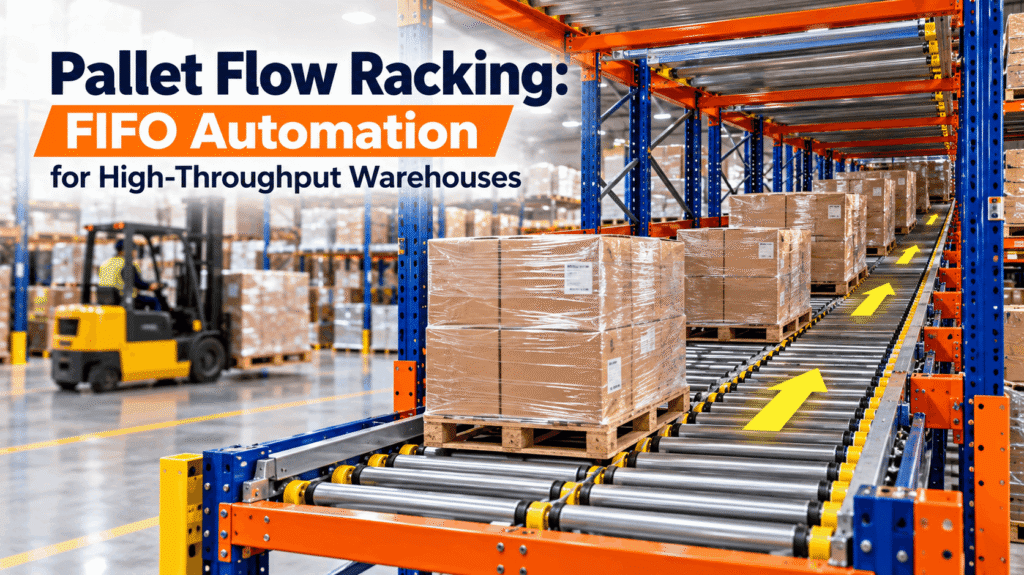
Warehouse inventory moves in and out every single day, and how fast it moves determines whether you’re optimizing space or wasting it. For Ontario facilities handling high-volume, fast-moving inventory, pallet flow racking automates the entire process. Instead of manually rotating pallets and managing inventory order, gravity does the work.
Success Storage Solutions helps Mississauga and GTA warehouses implement pallet flow systems that turn FIFO principles into everyday operations, reducing labor costs while keeping product rotation automatic and foolproof. Understanding when pallet flow makes sense, and how it compares to other storage systems is crucial before making the investment.
What Is Pallet Flow Racking & How Does FIFO Automation Actually Work?
Pallet flow racking operates on a simple principle: gravity-powered storage that rotates inventory automatically. When you load a pallet on the high end of an inclined track system, it advances slowly down rollers toward the low end where you pick it. No manual intervention. No forklift traffic inside the rack. Just consistent, FIFO-driven material flow that works 24/7 without operator involvement.
To understand pallet flow in context, it helps to see how it compares to all warehouse racking options. Success Storage Solutions maintains a comprehensive guide to warehouse racking systems that breaks down selective, drive-in, push-back, cantilever, mezzanines, and flow systems side by side. Pallet flow sits in the high-density, FIFO-focused category different from the other systems in critical ways.
H3 #1a: Understanding Gravity-Driven Pallet Movement
The system uses rollers mounted on a slight incline (typically 4-6 degrees). Load a pallet at the top, and it glides forward at controlled speed due to gravity. Brakes and velocity controls regulate the movement so pallets don’t crash or move too fast. Each new pallet entering the system automatically advances the queue, ensuring the oldest pallet reaches the pickup end first.
The braking mechanism is engineered to your product weight. Heavier pallets move faster; lighter ones slower. This calibration happens during installation and is verified during your PSR inspection.
FIFO Workflow: First-In-First-Out in Practice
FIFO means the first pallet you load is the first one you pick. This matters enormously for perishables, dated inventory, and just-in-time operations. With pallet flow racking, FIFO happens automatically, no date-checking, no manual queue management, no product expiration risk. The system enforces rotation without thinking.
For manufacturers and food warehouses, this automatic rotation is non-negotiable. Compliance happens by design, not by procedure.
Pallet Flow vs. Carton Flow: System Comparison
Don’t confuse pallet flow with carton flow. Pallet flow handles unit loads (50-100+ pound pallets of full cases). Carton flow handles individual cases and smaller items for faster-moving SKUs. Both use gravity, but pallet flow is designed for heavier, deeper inventory buffers while carton flow maximizes throughput for lighter picks.
If you’re evaluating whether pallet flow or carton flow fits your operation, Success Storage Solutions published a detailed comparison in the Carton Flow vs. Pallet Flow Racking guide that covers throughput, space, and operational fit.
When Does Pallet Flow Racking Actually Make Sense for Your Warehouse?
Pallet flow works best in specific operational scenarios. It excels when inventory rotates consistently, when FIFO compliance is non-negotiable, and when single-touch handling outweighs the need for random access. Understanding where pallet flow delivers value—and where it creates constraints determines whether it fits your facility.
Before committing to pallet flow, assess your warehouse’s current design and throughput patterns. Success Storage Solutions offers a Warehouse Design & Layout consultation service that analyzes your operation to determine which racking system maximizes both density and efficiency for your specific inventory flow.
Five Operational Scenarios Where Pallet Flow Succeeds
High-velocity inventory with regular rotation benefits immediately from automated FIFO. Manufacturing plants use pallet flow for work-in-progress staging, where materials enter one end and exit the other in predictable sequence. Perishable goods—food, pharmaceuticals, chemicals depend on pallet flow to eliminate rotation errors. Just-in-time operations rely on consistent, dated material flow. Multi-SKU pallets with expiration dates or batch tracking require FIFO automation to stay compliant.
When all five of these apply to your operation, pallet flow transforms from nice-to-have to essential.
Throughput & Labor Reduction Benefits
Pallet flow racking delivers throughput gains other systems can’t match. Picking speeds increase because pallets advance automatically—no searching, no manual repositioning. Forklift traffic inside the warehouse drops significantly since internal pallet movement happens via gravity, not equipment. This reduces fuel consumption, equipment wear, and accident risk. Single-handling operations cut labor hours per pallet moved. For high-velocity operations, the labor savings alone justify the investment within 3-5 years.
Space Density & Depth Advantages
Pallet flow stores 10-20 pallets deep in a single lane. You gain density advantages similar to drive-in systems but with FIFO certainty. The depth capacity means fewer aisles, more usable warehouse floor, and better space utilization than selective racking. In a facility where floor space costs are high, and Mississauga/GTA warehouse lease costs are among the highest in Canada this density matters.
When Should You Avoid Pallet Flow Racking?
Pallet flow racking isn’t universal. If your operation demands random access to any pallet at any time, pallet flow creates bottlenecks instead of efficiency. If inventory sits static or moves slowly, gravity systems waste valuable space. Understanding when to say no prevents costly installation mistakes.
Forced pallet flow into the wrong operation kills ROI and frustrates teams daily. Honest assessment upfront saves months of regret.
Five Reasons Pallet Flow Doesn’t Fit Every Warehouse
Random access needs kill pallet flow viability. If you need to pick SKU X from the middle of a lane without touching pallets in front or behind, selective racking is the answer, not pallet flow. Slow-moving inventory clogs the system—if pallets sit for weeks, gravity positioning wastes depth and density. Mixed pallet sizes and weights break velocity control; the braking system can’t accommodate inconsistent loads reliably. Limited facility depth becomes a constraint; pallet flow requires minimum 10-pallet depth to justify the investment. Inconsistent demand patterns defeat FIFO logic; if you pick randomly instead of sequentially, the system’s automation advantage disappears. Even one of these five issues is enough reason to choose a different system.
Maintenance Reality & System Reliability
Pallet flow requires more upkeep than selective racking. Roller tracks wear over time, velocity control degrades, and damaged pallets can jam the system. Regular servicing is non-negotiable. If your facility can’t commit to quarterly inspections and annual deep maintenance, pallet flow reliability suffers.
Success Storage Solutions’ Inspection, Repair & PSR service covers ongoing maintenance and keeps your pallet flow system performing at peak efficiency throughout its lifespan.
How Does Pallet Flow Compare to Selective, Drive-In & Double-Deep Racking?
Choosing between racking systems means understanding trade-offs. Pallet flow offers FIFO automation and strong throughput, but sacrifices random access. Selective provides access but no automation. Drive-in maximizes density but uses LIFO, not FIFO. Double-deep splits the difference but requires specialized equipment.
The right choice depends on your specific operation’s priorities: access, density, throughput, or compliance.
Pallet Flow vs. Selective Racking
Selective racking lets you access any pallet anytime. Pallet flow forces sequential access only. Selective handles mixed throughput and random demand; pallet flow demands predictable, sequential operations. Throughput per labor hour favors pallet flow. Space efficiency favors selective for low-velocity SKUs.
If your operation has both high-velocity items and slow-moving SKUs, you might hybrid-install selective racking in one zone and pallet flow in another.
Pallet Flow vs. Drive-In Racking
Drive-in systems stack 8-12 pallets deep per lane and maximize density. But drive-in operates LIFO (last in, first out), meaning the last pallet loaded is the first one picked. If your operation requires FIFO, drive-in fails.
Success Storage Solutions has detailed a complete comparison in the Selective vs. Drive-In Pallet Racking guide. Pallet flow delivers FIFO with gravity automation; drive-in requires forklifts navigating narrow aisles and can’t guarantee rotation order.
Pallet Flow vs. Double-Deep Racking
Double-deep stores 2 pallets deep per position, accessed by reach-truck equipment. It compromises between selective access and drive-in density. Double-deep doesn’t enforce FIFO; pallet flow does automatically. Double-deep needs reach-truck operation; pallet flow operates hands-free once loaded.
For operations where FIFO is mandatory but you need slightly more access flexibility than pure pallet flow allows, double-deep becomes a middle-ground option worth evaluating.
What’s Involved in Installing Pallet Flow Racking in Ontario?
Installation isn’t just bolting frames together. Pallet flow systems demand precise floor prep, velocity calculations, and integration with your warehouse workflow. Ontario facilities must account for building code compliance and PSR requirements before the first roller goes down.
Success Storage Solutions manages the entire installation process from design through operation, coordinating with your team to minimize disruption.
Pre-Installation Site Assessment & Design Decisions
Success Storage Solutions starts with warehouse design review. Floor slope matters—pallet flow requires slope within tolerances, typically ±0.25 inches over 20 feet. Aisle width, ceiling height, and dock configuration determine whether pallet flow integrates smoothly. Load weight and pallet consistency must be analyzed; the velocity control system is calibrated to your specific product weight.
Our Warehouse Design & Layout service handles this assessment phase, optimizing your facility layout to support pallet flow without workflow conflicts.
Installation Timeline & Integration
Foundation and track leveling is the critical first phase; poor leveling undermines the entire system. Roller installation and velocity testing follows. Integration with loading docks and conveyor systems requires coordination. Typical pallet flow installation takes 4-8 weeks depending on system size and facility complexity.
Our Racking Installation service manages all phases with minimal operational disruption. We work around your existing schedule to keep your warehouse running.
Equipment Integration for Your Workflow
Pallet flow works best with consistent loading from one side only. Dock layout optimization ensures forklifts load efficiently without cross-traffic. Reach trucks or standard forklifts can load the system; the choice depends on aisle width and your existing equipment fleet.
What Safety & Compliance Standards Apply to Pallet Flow Racking in Ontario?
Pallet flow racking must meet Ontario safety standards and Pre-Start Health and Safety Review (PSR) requirements. The braking and velocity control system is a critical safety component, and inspections verify proper function before operation. No shortcuts exist here. Compliance isn’t optional in Ontario warehouses.
PSR Certification & Compliance Requirements
New installations require a Pre-Start Health and Safety Review per Ontario Regulation 851. The review verifies load capacity, velocity control calibration, track installation precision, and pallet consistency. Before you move inventory into the system, the entire installation must pass official inspection.
Success Storage Solutions’ Inspection, Repair & PSR service handles certification verification and documentation, ensuring your facility meets all provincial requirements.
Ongoing Maintenance & Safety Inspection
Quarterly visual inspections catch worn rollers and brake degradation early. Annual servicing recalibrates velocity controls and replaces worn components. Damaged pallet prevention protocols protect system reliability; bent or cracked pallets jam the mechanism. Regular maintenance keeps the system safe and functional.
CSA A344 & Building Code Compliance
Pallet flow systems must meet CSA A344 standard for load rating and safety documentation. Ontario Building Code Part 2, Section 2.8 governs aisle width and structural requirements. Success Storage Solutions ensures every installation meets provincial standards before pickup begins.
FAQs
Can I retrofit existing warehouse space with pallet flow racking?
Possible if floor is level and depth permits. Assessment during warehouse design phase confirms feasibility before commitment.
What happens if a pallet gets stuck or damaged in the system?
Manual removal required; flow resumes after removal. Consistent pallet condition prevents jams damaged pallets are the leading cause of system interruption.
How does pallet flow rotate inventory automatically without operator input?
FIFO advance is mechanical and gravity-powered. New pallets entering push older pallets toward the pickup end continuously; no operator intervention needed.
Does pallet flow racking require reach trucks or standard forklifts?
Standard forklifts work for loading. Reach trucks optional depending on aisle width; warehouse design determines equipment needs.
How often does pallet flow racking need maintenance?
Quarterly inspections minimum; annual deep servicing recommended. Cost is higher than selective but offset by labor savings in high-velocity operations.